Plinko at Crypto Casinos in Ireland: How the Ball Really Falls, Risk Levels, RTP and Session Maths
Welcome bonus for new players + fast crypto payouts. Just helping a brother out.
18+. Crypto deposits. Cloudbet is licensed in Curaçao and is NOT licensed by the GRAI. Irish gambling law changed in 2026: only GRAI-licensed operators may lawfully take bets from Irish customers. Ad: we may earn a commission. Bet only what you can afford to lose.
Plinko looks like the simplest game in any crypto casino. You drop a ball, it bounces off pegs, and it lands in a slot with a multiplier underneath. No cards to learn, no strategy chart. But there's proper maths hiding behind those bouncing balls, and once you see it, you'll understand why the edges pay a thousand times your stake and why you'll almost never see them. This guide breaks it down the way a mate who did the sums would: how the ball really falls, what the row and risk settings change, what RTP means here, and how a session actually tends to go.
18+ only. General information, not a recommendation to gamble. The paytables and simulations below are our own made-up examples to show how the game works, not any casino's real figures; real Plinko games publish their own tables. Ireland's regulator, the Gambling Regulatory Authority of Ireland (GRAI), has not issued any online casino licences yet, and offshore crypto casinos (including Cloudbet, which we link to and which holds a Curaçao licence, and others such as Stake or BC.Game) are not licensed in Ireland. If gambling is getting on top of you, Gambling Care is free and open 24/7 on 1800 936 725 (Northern Ireland: 08000 886 725).
The short version
- Every bounce is a coin flip. At each row of pegs the ball goes left or right with equal odds. That makes Plinko a textbook binomial distribution: most balls land in the middle.
- The edges are very rare. On a 16-row board, the chance of hitting one particular edge slot is about 1 in 65,536. Either edge together is about 0.003%.
- RTP and volatility are different things. Low-risk and high-risk settings can have the same RTP. What changes is how bumpy the ride is.
- In our simulation, both a low-risk and a high-risk table lost about 1% of what was wagered on average, but the high-risk player's results ranged far wider.
- No pattern or strategy changes the odds. You can choose how volatile the game is, not whether you have an edge.
- Licensing: no Plinko site is licensed in Ireland, because no online casino is yet.
Where Plinko comes from
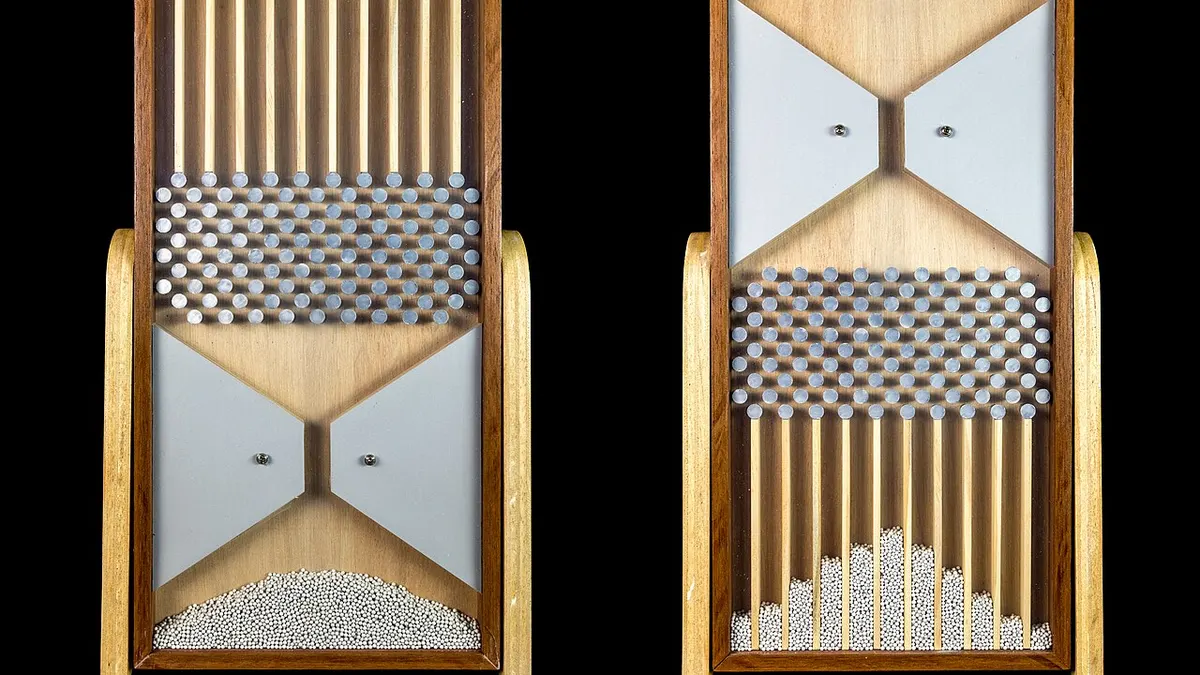
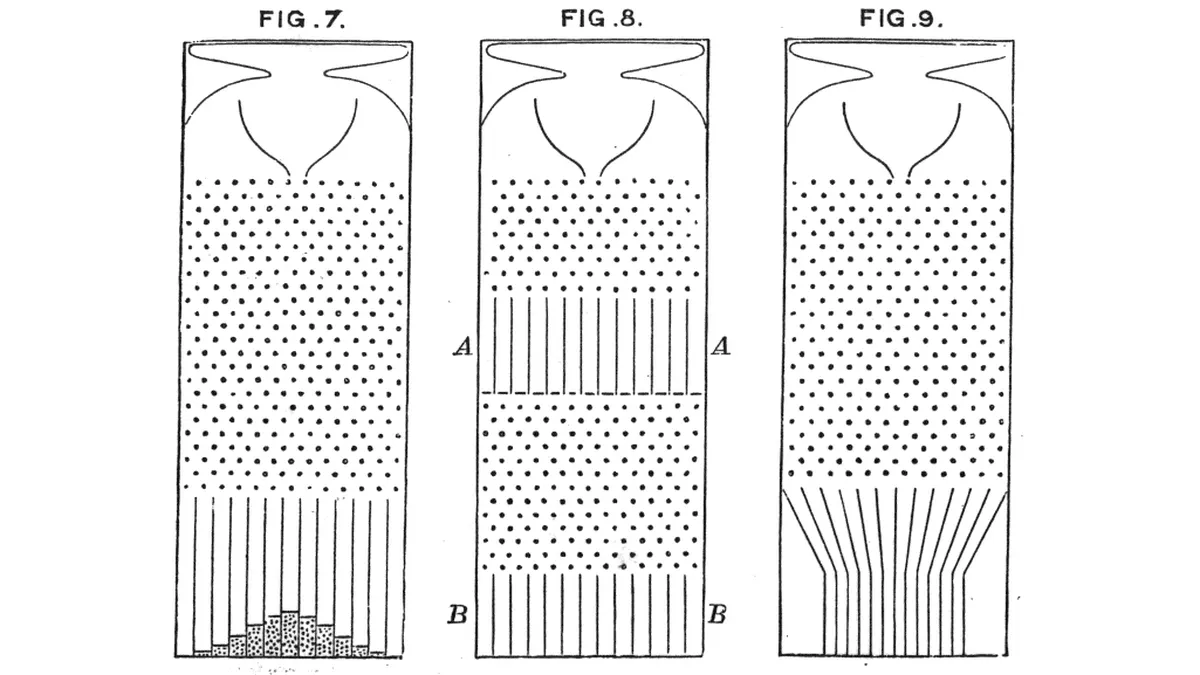
Plinko is the casino version of a peg-board game made famous on American TV, and it's a cousin of the Galton board, a device invented by the Victorian scientist Francis Galton to show how random events pile up into a bell curve. Drop enough balls through a field of pegs and they always stack highest in the middle and lowest at the edges. The photos on this page show exactly that: a physical Galton board and Galton's own 1889 drawing. Crypto casinos turned the idea into a fast online game, usually with adjustable rows and risk levels, and often with "provably fair" results you can check yourself.
How the ball really falls
Picture a board with 16 rows of pegs. The ball has to pass all 16. At each one it goes left or right, 50/50. Where it lands depends only on how many times it went right. Land on the far left, and it went left every single time; land in the middle, and it went right roughly half the time.
The number of paths into each slot is a binomial coefficient, and the chance of each slot is that number divided by 2 to the power of the rows. Here's what that looks like for three common board sizes. The tables show the left half; the right half mirrors it.
8 rows (9 slots)
| Slot (from edge) | Edge | 2nd | 3rd | 4th | Middle |
|---|---|---|---|---|---|
| Chance per drop | 0.39% | 3.13% | 10.94% | 21.88% | 27.34% |
12 rows (13 slots)
| Slot | Edge | 2nd | 3rd | 4th | 5th | 6th | Middle |
|---|---|---|---|---|---|---|---|
| Chance | 0.024% | 0.29% | 1.61% | 5.37% | 12.09% | 19.34% | 22.56% |
16 rows (17 slots)
| Slot | Edge | 2nd | 3rd | 4th | 5th | 6th | 7th | 8th | Middle |
|---|---|---|---|---|---|---|---|---|---|
| Chance | 0.0015% | 0.024% | 0.18% | 0.85% | 2.78% | 6.67% | 12.22% | 17.46% | 19.64% |
Look at how fast the edges fade. With 8 rows, an edge slot comes up about once in 256 drops. With 16 rows, it's once in 65,536. That's why 16-row boards can advertise huge edge multipliers: the casino almost never pays them.
What the row setting changes
More rows means more slots and a more extreme spread of multipliers. Fewer rows means a tighter, more predictable game. In short:
- Fewer rows (8): edges come up more often, so their multipliers are smaller. Results stay closer together.
- More rows (16): edges are vanishingly rare, so they can carry giant multipliers. Middle slots usually pay less than your stake.
The row count doesn't, by itself, change the house edge. That's set by the paytable, which the game should show you before you drop.
What the risk level changes
Most crypto Plinko games offer low, medium and high risk. The risk setting reshapes the paytable: low risk pays something near your stake almost everywhere; high risk pays almost nothing in the middle and a fortune at the edges. To show how that plays out, we built two made-up 16-row paytables, each with an RTP of about 99% (a 1% house edge), which is in the range crypto casinos often advertise for in-house games. Treat these as illustrations, not any real game's numbers.
| Slot (from edge) | Edge | 2nd | 3rd | 4th | 5th | 6th | 7th | 8th | Middle |
|---|---|---|---|---|---|---|---|---|---|
| Low-risk example | 16x | 9x | 2x | 1.4x | 1.4x | 1.2x | 1.1x | 1.0x | 0.5x |
| High-risk example | 1,000x | 130x | 26x | 9x | 4x | 2x | 0.2x | 0.2x | 0.2x |
Both tables work out to about 99.0% RTP using the 16-row chances above. But look at what a single drop feels like:
- On the low-risk table, about 80.4% of drops return your stake or more.
- On the high-risk table, only about 21.0% do. The other 79% give you back a fifth of your stake.
Same average cost, completely different experience.
We simulated 20,000 sessions
To see what that means over an evening, we simulated 20,000 players each making 500 drops at €0.20 a drop (€100 wagered in total) on each of the two example tables.
| Result after 500 drops (€100 wagered) | Low-risk example | High-risk example |
|---|---|---|
| Average result | −€1.02 | −€1.05 |
| Typical (median) result | −€1.10 | −€7.40 |
| Players who finished ahead | 22.9% | 32.4% |
| Worst 5% did worse than | −€3.30 | −€24.20 |
| Best 5% did better than | +€1.58 | +€30.84 |
The averages are almost identical, about one euro per hundred wagered, exactly what a 1% house edge predicts. But the shapes are very different. On low risk, nearly everyone finishes within a few euro of where they started; it's a slow, gentle drain. On high risk, a third of players finish ahead, some well ahead, but the typical player is down more, and the unlucky end is much deeper. Neither setting is "better". Pick the ride you're comfortable with, and size your stake to match.
One caution: real casino tables may have a higher house edge than our 1% example. A 3% edge would triple the average cost, to about €3 per €100 wagered. Always check the RTP the game states.
Sizing your stake to your budget
Because the house edge works on everything you wager, not just what you deposit, the cost of a Plinko session depends on how many drops you make and how big they are. A simple way to think about it: expected cost equals total wagered times the house edge. At a 1% edge, €100 of total drops costs about €1 on average; €1,000 of drops costs about €10. Auto-drop makes it easy to put a surprising amount through the board.
A practical plan for a €50 evening:
- Decide the number of drops you want, say 500.
- Pick a stake that keeps total wagering sensible. At €0.10 a drop, 500 drops is €50 wagered, with an average cost of about €0.50 at a 1% edge.
- On high risk, go smaller still. Long runs of 0.2x results are normal, so a stake that feels fine on low risk can burn through a budget quickly.
- Set a stop-loss and a stop-win in the auto-drop settings if the game offers them, or write them down if it doesn't.
- Cash out what's left at the end instead of rolling it into another session.
None of this changes the odds. It just makes sure the evening costs roughly what you expected, which is the most you can ask of any casino game.
Why strategies don't work
You'll see videos promising Plinko "systems": always drop from the left, switch risk after a loss, double your stake after three middle hits. None of them can work, for a simple reason. Each drop is independent, and in provably fair games the result is fixed by a cryptographic seed before the ball even appears. The ball's path on screen is just an animation of an outcome already decided. Changing your stake pattern changes how your results are spread over time, never the average.
Staking systems that raise your bet after losses, like Martingale, are especially dangerous on high-risk Plinko, where long runs of 0.2x results are normal. They turn many small wins into an occasional large loss.
18+. Crypto deposits. Cloudbet is licensed in Curaçao and is NOT licensed by the GRAI. Irish gambling law changed in 2026: only GRAI-licensed operators may lawfully take bets from Irish customers. Ad: we may earn a commission. Bet only what you can afford to lose.
Provably fair Plinko
Many crypto Plinko games are "provably fair". In plain terms: before you play, the casino commits to a hidden server seed by showing you its hash. You add your own client seed. Each drop's result comes from combining the two with a counter. Afterwards, the casino reveals the server seed, and you can check that it matches the hash and that it produces the results you got. It proves the casino didn't change outcomes after you bet. It doesn't change the house edge, which is still built into the paytable. Our provably fair explainer walks through a check step by step.
Plinko vs other quick crypto games
| Game | What you control | What decides the cost |
|---|---|---|
| Plinko | Rows, risk, stake | The paytable's RTP |
| Crash | When you cash out | The game's built-in edge |
| Dice | Win chance and payout | The edge baked into each payout |
| Slots | Stake only | The slot's RTP |
All of these are fast, which is part of the appeal and part of the risk. Our crash games guide covers the cash-out maths there.
Finding Plinko at a crypto casino
Plinko is common at crypto-native casinos, often as an "in-house" or "originals" game. Game lobbies change, so check the casino's lobby rather than relying on any list, and look for these before you play:
- The stated RTP in the game's info panel.
- The full paytable for your row and risk setting.
- Provably fair details, if offered, so you can verify results.
- Bonus rules. In-house games often count differently towards bonus wagering, or not at all.
- Stake limits, especially minimums, so you can size drops to your budget.
If you're playing at Cloudbet, its welcome package, when we checked, paid casino rakeback of 10% of the house edge during the first 30 days. On a 1% edge game, that's about €0.10 back per €100 wagered: small, but it's yours without wagering conditions. Don't play more to chase it.
Crypto money tips for Plinko
- Use a stablecoin like USDT if you don't want your balance moving with coin prices while you play.
- Match the network on deposit, and send a small test first. Our crypto casino deposit guide shows how.
- Withdraw winnings to your own wallet rather than leaving them on the site.
Is Plinko legal in Ireland?
Ireland's Gambling Regulation Act created the GRAI, which opened licence applications in February 2026. The first licences, from 1 July 2026, were for remote betting. Gaming licences, which cover online casino games like Plinko, aren't due until later years, so no online casino is GRAI-licensed yet. Cloudbet holds a Curaçao licence and is not licensed in Ireland; neither are Stake, BC.Game or the other offshore crypto casinos where Plinko is popular. That means no Irish complaints route if something goes wrong. Read our online casino legality guide and the Irish betting law guide. We're not lawyers.
Mistakes to avoid
- Thinking a run of middle hits means an edge is "due". It isn't; every drop is fresh.
- Playing high risk with a stake sized for low risk.
- Using auto-drop at high speed without a stop limit.
- Chasing losses with bigger drops.
- Ignoring the stated RTP.
Glossary
- Binomial distribution: the pattern you get from many independent 50/50 choices; it piles up in the middle.
- Multiplier: what a slot pays relative to your stake.
- RTP: return to player, the long-run share of stakes paid back.
- Volatility: how spread out results are around the average.
- Provably fair: a method for checking each result with cryptographic seeds.
- Auto-drop: a setting that drops balls automatically at a chosen stake.
Mind yourself
Plinko is quick, hypnotic and easy to run on auto. A thousand drops can go by in minutes. Set a money limit and a time limit before you start, and stick to both. If you're finding it hard to stop, or you're playing to win back losses, talk to someone. Gambling Care's helpline is free, confidential and open 24/7 on 1800 936 725. Our responsible gambling page lists more support.
My take
Plinko is honest maths dressed up as a bouncing ball. Every drop is a run of coin flips, the middle always wins out, and the giant edge multipliers are priced for how rarely they hit. Choose rows and risk for the kind of ride you want, check the RTP, keep stakes small enough that a long bad run doesn't hurt, and treat it as entertainment with a price tag. And remember that no Plinko site is licensed in Ireland, so you're relying on an offshore casino's terms.
Questions players ask
Is Plinko rigged?
Each drop is random, and provably fair versions let you verify results with cryptographic seeds. The house edge is built into the paytable, not into hidden tricks. Check the RTP the game shows.
What are the odds of hitting the edge in Plinko?
On a 16-row board, about 1 in 65,536 for one particular edge slot, or about 0.003% for either edge. On 8 rows, about 1 in 256 per edge.
Is low risk or high risk better in Plinko?
Neither has better odds if the RTP is the same. In our simulation, both lost about 1% of wagers on average; high risk just produced bigger swings either way.
Is there a Plinko strategy that works?
No. Each drop is independent and the result is fixed before the animation. Strategies change how your results are spread, not the average.
What RTP does Plinko have?
It varies by game and setting; check the info panel. Our examples used about 99% to show how the game works, but real tables can differ.
Is Plinko legal in Ireland?
No online casino is licensed by the GRAI yet, and offshore crypto casinos offering Plinko aren't licensed in Ireland, so no Irish regulator can help with disputes.
How many rows should I pick in Plinko?
It's a matter of taste, not odds. Fewer rows (such as 8) give a tighter game where edges come up about once in 256 drops; more rows (such as 16) make edges far rarer but let them pay much bigger multipliers. Check the RTP for each setting.
18+. Crypto deposits. Cloudbet is licensed in Curaçao and is NOT licensed by the GRAI. Irish gambling law changed in 2026: only GRAI-licensed operators may lawfully take bets from Irish customers. Ad: we may earn a commission. Bet only what you can afford to lose.
If betting is costing you more than money, free and confidential help is there 24 hours a day, 365 days a year: the Problem Gambling Helpline run by Dunlewey Addiction Services for Gambling Care, on 1800 936 725 (from Northern Ireland: 08000 886 725). Source: grai.ie.